


If you’ve been around crypto long enough, you’ve probably noticed a pattern:
Most decentralized exchanges (DEXs) are great for swaps, but when it comes to advanced trading—tight spreads, fast fills, deep liquidity, perpetuals, and pro-style execution—traders often end up back on centralized exchanges (CEXs).
Hyperliquid is one of the most notable attempts to close that gap.
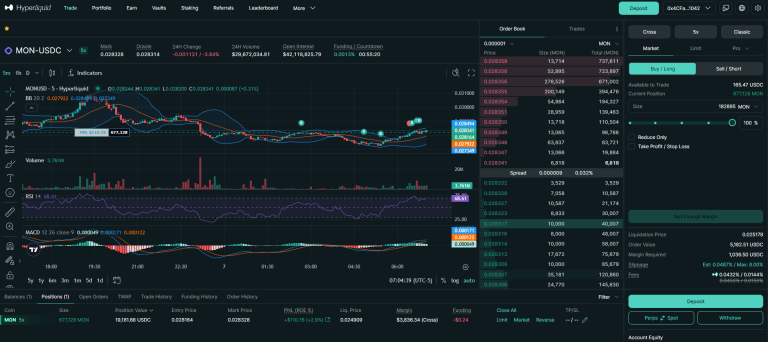
It’s a high-performance Layer-1 blockchain with an integrated decentralized exchange, best known for perpetual futures (perps) and a trading experience designed to feel closer to a CEX—while remaining non-custodial and onchain.
This guide explains what Hyperliquid is, how it works, why advanced traders care, and what risks you should understand before using it.
Hyperliquid is a purpose-built Layer-1 chain + DEX designed for fast, order-book style crypto trading—especially perpetual futures—aimed at serious, active traders.

Traditional DeFi trading had a few pain points for active traders:
Slow execution (especially during volatility)
High fees at times on popular networks
AMM limitations (slippage, price impact, less “pro” order placement)
Fragmented tools and inconsistent UX
Hyperliquid’s goal is to deliver:
Speed and responsiveness closer to centralized exchanges
Onchain transparency and self-custody
A unified environment where liquidity and trading live on one platform
Many DEXs run on top of other chains. Hyperliquid is itself a Layer-1 blockchain built specifically for trading performance.
This matters because performance (latency, finality, throughput) is often the biggest barrier for advanced DeFi trading.
A big distinction: Hyperliquid is known for using a central order book style model rather than the classic AMM-only approach—closer to how centralized exchanges match buyers and sellers.
For traders, that typically means:
More familiar execution mechanics
Better fit for limit orders and active trading styles
A “pro trading” feel compared with pure AMM swaps
Hyperliquid’s ecosystem is often described as having:
HyperCore: the core trading layer that runs the exchange logic (order book/perps)
HyperEVM: an Ethereum-compatible environment for smart contracts that inherits the chain’s security properties.
For builders, HyperEVM being EVM-compatible means familiar tooling and contract patterns can be used.
Hyperliquid references HyperBFT as its consensus mechanism, built for fast confirmations and trading-focused performance.
For traders, the takeaway is simple:
Faster confirmations and smoother UX can improve fills and reduce “DeFi friction” during fast markets.

Hyperliquid is best known for:
Perps are derivatives that let you go long/short with leverage without an expiry date—popular for active traders.
Hyperliquid’s docs describe funding as designed to resemble CEX perp mechanics, with funding calculated on an 8-hour basis but paid hourly in smaller increments.
Some overviews describe Hyperliquid as supporting spot trading alongside perps, though the platform’s reputation is most strongly tied to perps.
If you’re advanced, you already know the biggest danger in perps isn’t “being wrong”—it’s leverage + liquidation mechanics.
Funding is a periodic payment between longs and shorts meant to keep the perp price aligned with spot.
Hyperliquid’s docs describe:
An 8-hour rate framework
Funding paid hourly (1/8 of the computed 8-hour rate per hour)
A premium-index-based formula sampled frequently.
Practical meaning: funding can materially affect PnL for longer holds, especially in crowded trades.
Liquidation occurs when your account equity drops below maintenance margin requirements.
Hyperliquid’s liquidation documentation describes maintenance margin as half of initial margin at max leverage, varying by asset (examples in the docs indicate max leverage can range and maintenance margin depends on that). Similiar to a margin call for equity trading.
Practical meaning: higher leverage gives less room for volatility. In crypto, that’s a recipe for getting wicked out if you’re not careful.

Hyperliquid’s ecosystem includes a native token, HYPE, used in the network—such as gas for HyperEVM according to Hyperliquid documentation.
There has also been significant attention around HYPE distribution and ecosystem events (for example, major airdrop coverage and ongoing ecosystem updates have been widely discussed).

Here are the key reasons Hyperliquid gets attention from experienced traders:
The blend of:
order-book style execution with
DeFi transparency and non-custodial ethos (as positioned in many ecosystem descriptions)
is the core appeal.
As a trading-focused L1 with HyperBFT consensus references, it’s designed to reduce the “lag” people associate with DeFi trading.
Analytics and onchain visibility are often highlighted as an advantage vs opaque CEX internals (and tools like Nansen track the ecosystem).
Even advanced traders should treat Hyperliquid like a serious tool with real risks:
Even if execution feels CEX-like, it’s still DeFi architecture and carries protocol risk.
Perps can liquidate you fast in crypto, especially with high leverage. Hyperliquid’s liquidation mechanics and maintenance margin structure reinforce this reality.
Funding can drain PnL if you hold the wrong side during persistent premiums/discounts.
Any new ecosystem has operational and infrastructure risks. Always use strict position sizing and risk controls.
(Not financial advice—just risk reality.)
Define your max risk per trade (e.g., % of account)
Select leverage deliberately (lower is often better)
Know your liquidation price before entry
Check funding conditions (don’t ignore it)
Use limit orders when possible
Journal each trade (setup, entry, invalidation, outcome)
If you’re an advanced trader who wants:
Perps + leverage tools
Order-book style execution
DeFi transparency/self-custody principles
A performance-first environment built for trading
…then Hyperliquid is absolutely worth understanding.
Just treat it with the respect you’d give any high-powered trading venue: risk first, always.